
A Drupal requirement can arrive as a redesign brief, an ongoing support engagement, a specialist contract, or a permanent role. Those formats ask different things of a supplier. Counting them together is a useful starting point; reading them as equally suitable agency leads would skip the most important decision.
A snapshot of released Drupal records
This article freezes the aggregate figures displayed in the public Drupal opportunity hub when retrieved on 29 September 2026 at 09:57 UTC. The denominator is all 114 published Drupal-tagged records in that catalog at that moment. We applied no first-observed date filter.
The snapshot therefore describes the catalog available on that date. It does not mean 114 opportunities were first observed in September, and it does not cover a completed September reporting period. Source status can change after observation, so a published record is not proof of a current opening.
The public catalog and Hiring Pulse draw from the same imported opportunity stream, but they answer different questions. Hiring Pulse measures observations in a verified time window. The public catalog includes the subset released after its delay, quality checks, and publication limits. The format figures below belong to that catalog subset; they are not a Drupal work-format breakdown of the full Hiring Pulse sample.
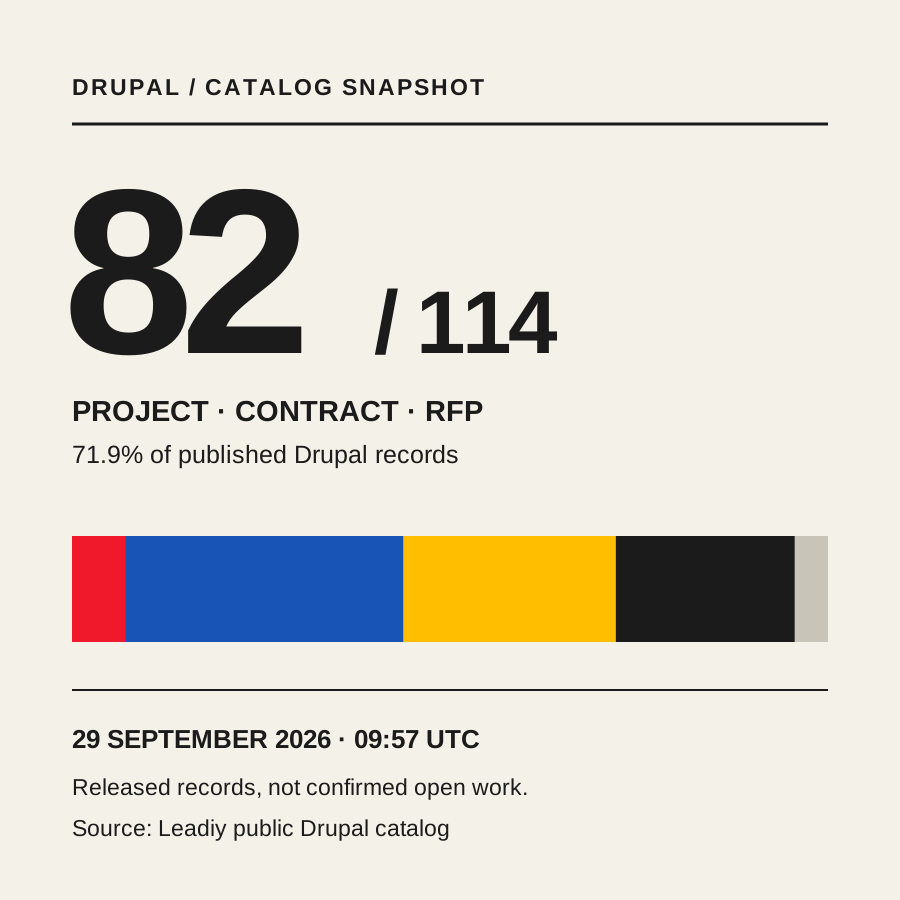
82 of 114 were project, contract, or procurement records
The catalog assigned 8 records to Project, 42 to Contract, and 32 to RFP / procurement. Together these were 82 records, or 71.9% of the frozen catalog. Hiring accounted for 27 records, with another 5 classified as Other / unclear.
| Work format | Records | Share |
|---|---|---|
| Project | 8 | 7.0% |
| Contract | 42 | 36.8% |
| RFP / procurement | 32 | 28.1% |
| Hiring | 27 | 23.7% |
| Other / unclear | 5 | 4.4% |
For an agency, the practical implication is to search beyond permanent job titles and then qualify each result. A procurement record may require a formal supplier response. A contract may seek one named specialist. A project may offer a bounded outcome without enough scope to estimate it. The combined 82 is a work-format count, not a count of buyers confirmed to accept agencies.
Only 18 of the 114 records carried non-empty budget wording. That measures the presence of a field, not an available spending total. Published values can describe a rate, salary, project price, framework ceiling, or contract value. We have not added those unlike amounts together or inferred the missing budgets.
What the recorded work looks like
Three public records show how a broad Drupal label becomes a qualification question. These are selected illustrations, not an exhaustive taxonomy. Redesign, support, migration, and ongoing development can overlap; this article assigns no counts or shares to those scope categories.
Redesign with a named target platform
C004309 — NYMTC Website Redesign to Drupal Platform was first observed on 14 September 2026 and classified as RFP / procurement. The public record discloses dot.ny.gov as its response destination. Its title gives a target platform and a redesign outcome; an agency still needs the source documents to assess content migration, integrations, accessibility requirements, deliverables, and response eligibility.
Support paired with further development
Drupal Support and Strategic Development Services, first observed on 13 September 2026, is another procurement record. Its disclosed destination is a summary on thebiddaily.com, and the public budget field is missing. The useful next step is to follow the source route and verify the procurement documents, current status, support obligations, and how new development is commissioned.
Updates and performance on an existing site
Drupal 11 website updates and performance work, first observed on 12 September 2026, is classified as Contract and points to upwork.com. An existing-site engagement raises different questions from a rebuild: access, the current codebase, performance targets, acceptance criteria, and whether the buyer wants an individual or a team.
These dates record when Leadiy first observed each opportunity, not when its source originally published it. The source controls the latest scope, deadline, eligibility, and response terms. The examples are evidence of observed demand even if a response window has since closed.
Turn a platform match into an agency decision
The format mix helps decide where to look. Qualification decides whether to spend time on a response. A short review can focus on four questions:
- ScopeWhat must be delivered or maintained? Confirm the Drupal version, integrations, ownership, and acceptance criteria in the source.
- Supplier fitDoes the buyer accept an agency, a named contractor, or only an employee? Check location and procurement restrictions.
- Commercial termsLook for an actual budget or rate, its currency and unit, duration, and payment terms. A missing field needs confirmation.
- TimingVerify that the source still accepts responses and that the proposed schedule fits your available team.
For earlier personal discovery, Leadiy’s Drupal agency workflow matches your selected technologies and company context, then gives you a private pipeline for the records you choose. The public catalog remains available without sign-in for inspecting examples and source destinations.
Method, sources, and limits
- One dated response. All catalog totals and format counts were transcribed from the same successful direct HTTP response from the Drupal hub at . The source response was dated 09:57:05 UTC. The JSON snapshot preserves the counts, denominator, and calculation.
- Selection matters. Leadiy observes configured sources rather than every Drupal opportunity. Public eligibility starts after a deterministic 24–48 hour delay; quality checks and release caps can postpone actual publication further. This inventory is selected by those release rules.
- Two counting rules. Work formats use one primary category per record and sum to 114. Technology labels overlap, so a Drupal record may also appear in another technology hub. Adding hub totals would double-count some records.
- No monthly or growth claim. No first-observed date range was applied. September was not complete at retrieval. We use no historical comparison and make no claim about market growth, total Drupal demand, or the number of open projects.
- No inferred buyer outcomes. The snapshot does not measure agency eligibility, available spend, responses, awards, completed work, or customer success. Selected examples do not establish the distribution of build, support, or migration work.
- Public evidence only. The frozen file contains aggregates. This article uses already public record pages and excludes private contacts, internal notes, raw rows, and outreach copy. Read the shared methodology and Hiring Pulse definitions for the broader observation process.
Browse the Drupal projects, contracts, and RFPs catalog to inspect the current public inventory. To try matching against your own agency profile, sign in with Google: the free trial lasts two hours and includes up to 20 relevant records across leads and opportunities.
Start your free 2-hour trial