
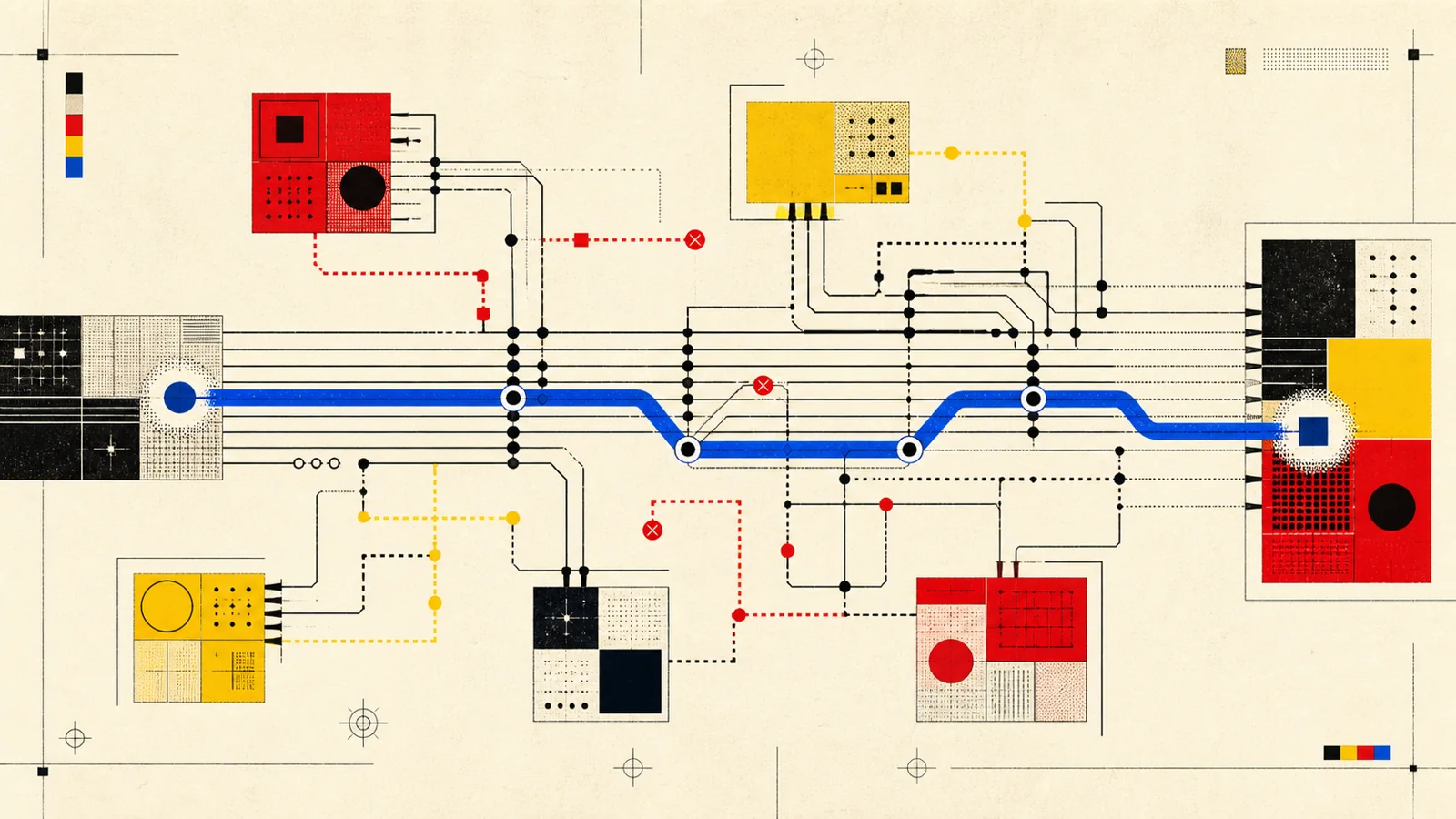
Most automation work begins in a place nobody planned to build a system: a spreadsheet beside a CRM, an inbox forwarding data to another inbox, a person copying the same field every Friday because two tools do not speak.
The work looks small. The dependence on it is not.
The work between the systems
Software teams tend to name the systems they own. There is a sales platform, a billing platform, a support platform, and a database. What remains unnamed is the journey between them. A lead arrives from a form. Someone checks it, cleans it, enriches it, creates a record, assigns an owner, sends a message, and returns later to see whether any step failed.
When that journey is manual, the organization often calls it a process. When it breaks often enough, the same sequence becomes software work.
This is the territory in which n8n appears. The product offers a visual way to connect services and add code where the workflow needs more than a configured step. That combination makes it legible to two groups at once: operators who understand the process and developers who understand the failure modes. It also makes the work easy to underestimate. A line between two nodes looks finished long before the underlying responsibility is settled.
The opportunity is therefore not only to build an automation. It is to make a formerly invisible dependency explicit: what begins the process, what data it is allowed to move, what counts as success, who sees a failure, and how the business continues when one service is unavailable.
Thirty-three signals in 340 opportunities
In the fixed Leadiy Hiring Pulse snapshot used for this article, n8n appeared in 33 of 340 software opportunities. That is 9.7%, or roughly one opportunity in ten.
The denominator matters. These are opportunities captured by Leadiy's configured feed, not 340 companies, not 340 full-time jobs, and not a census of software spending. Technology categories are multi-label, so an opportunity that mentions n8n may also mention an API, a CRM, JavaScript, WordPress, or another automation tool. The percentage measures incidence inside this sample. It is not market share.
| Technology label | Opportunities | Incidence |
|---|---|---|
| n8n mentioned | 33 | 9.7% |
| n8n not tagged | 307 | 90.3% |
| Full sample | 340 | 100% |
A named tool appearing in 33 records is not proof that it is new, dominant, or growing. It is evidence of something narrower and still useful: buyers and intermediaries used the tool's name often enough for it to become a visible search category. The work between systems is not only being performed. It is being briefed.
A second signal from a much larger market
A separate dataset points in the same direction. Malt's 2026 Tech Trends report, built from 2.5 million searches in its own marketplace, reports a fourteen-fold increase in demand for n8n on Malt. The figure is striking. It is not a multiplier that can be applied to Leadiy's 9.7%.
The two sources observe different populations, periods, user actions, taxonomies, and markets. Leadiy counts tagged opportunities in a fixed sample. Malt analyzes searches in its ecosystem. One cannot validate the other's exact rate, and their numbers should not be added or directly compared.
What they can do together is reduce the chance that the Leadiy count is merely an isolated curiosity. In a small directional snapshot, n8n was explicit in roughly one in ten opportunities. In a much larger but methodologically different marketplace, searches accelerated sharply. The careful conclusion is not that every company now needs an n8n specialist. It is that automation has become specific enough for buyers to ask for a particular tool.
Leadiy's 33 of 340 measures opportunity incidence. Malt's 14× figure measures change in demand within Malt's own search ecosystem. They support a directional observation only; neither source supplies the missing historical baseline for the other.
Low-code changes who can begin. It does not remove what happens next.
A visual workflow compresses the distance between understanding a process and prototyping it. The person who knows why a lead must be enriched before assignment can begin arranging the steps without first designing an application. That is a meaningful shift in access. It is not the end of engineering.
Production begins when the workflow meets time, volume, permissions, and change. Credentials expire. An API returns twice. A webhook arrives out of order. A salesperson renames a status. A service accepts a request but delays the result. The workflow succeeds on screen and creates a duplicate invoice in the business.
The questions that follow are less visual:
- Identity and accessWhich credentials may the workflow use, where are secrets stored, and how quickly can access be revoked or rotated?
- Repeat safetyIf the same event arrives twice or a step is retried, can the workflow complete without creating a duplicate customer, payment, ticket, or message?
- Failure recoveryWhich errors retry automatically, which require a person, and what state is preserved between the original execution and the repair?
- ObservationWho knows that the workflow stopped, what evidence can they inspect, and how quickly must the process be restored?
- Change ownershipWho tests a new node version, an altered payload, or a business-rule change before it reaches production?
These are not concerns invented to make a simple tool sound difficult. n8n's own documentation includes facilities for inspecting executions and retrying failed ones. Its execution guidance distinguishes production runs and explains retry behavior. Its security audit documentation checks areas including credentials, webhooks, community nodes, and instance settings. The platform acknowledges operational responsibility because real workflows acquire it.
The canvas describes the happy path. The service is the promise that the path can recover.
Sell the operating result, not the canvas
A specialist can describe automation as a list of nodes: connect the form, call the API, update the CRM, send the Slack message. That is accurate and weak. The client is not buying the distance between boxes. The client is buying fewer manual handoffs, a shorter response time, a clean record, and a known way back when the process fails.
Three offers make that value easier to see. They are editorial recommendations derived from the shape of the work, not categories measured in the Hiring Pulse dataset.
- Workflow auditMap one process from trigger to owner, quantify manual steps and failure points, identify access risks, and leave a prioritized automation brief. The deliverable is a decision, not a diagram collection.
- Automation sprintShip one bounded workflow with acceptance criteria, test fixtures, named error states, human override, and an operator handoff. The boundary prevents a useful first system from becoming an endless integration project.
- Production hardeningReview an existing workflow for credential handling, retries, idempotency, logs, alerts, backups, version changes, and recovery ownership. The value is continuity, not added complexity.
The strongest proof is also operational. A screenshot shows that a workflow exists. A short case record shows that it reduced a four-hour reconciliation to twenty minutes, caught malformed records before import, or gave support a repair path that did not require the original builder. A buyer can carry those results into a budget conversation. They cannot do much with “42 nodes.”
This changes how the specialist positions the skill. n8n can be the implementation tool without becoming the entire promise. The durable promise is that a business process moves reliably between systems, with ownership that survives delivery.
What this signal cannot tell us
- It does not measure n8n market share, installed workflows, company adoption, unique buyers, or the number of n8n specialists.
- The records are software opportunities, not only jobs. Project, contract, employment, and procurement formats are present in the broader feed.
- The snapshot does not publish n8n-specific salaries, budgets, project sizes, duration, seniority, or technology co-occurrence.
- All records appear on four active observation dates, 27–30 August 2026. No comparable historical baseline was available, so 9.7% is not a growth claim.
- Leadiy's configured search defines the sample. The result is directional evidence, not a census of the global software market.
- Malt's 14× figure comes from a separate ecosystem and method. It cannot be used to estimate the change in Leadiy's feed.
The valuable automation is not the cleverest canvas. It is the one that still works when a credential expires, a payload changes, or the person who built it goes on holiday. Thirty-three opportunities are not a promise. They are a signal: the gaps between systems have become visible work.